Air Ambulance Week 2023
The start of September marks Air Ambulance Week, the only week in the year dedicated to raising awareness and funds for the lifesaving work done by air ambulance charities across the UK.
So who better to tell us what it’s like on the job than the crew members themselves?
The North West Air Ambulance Charity is not part of the NHS and doesn’t receive any government funding, meaning it is funded solely by public donations. We spoke to Dr Eimhear and Andy from the North West Air Ambulance Charity about their lifesaving work.
Andy is the Lead HEMS (Helicopter Emergency Medical Services) Paramedic for the healthcare charity’s emergency helicopter and vehicle crews, and he has worked with the charity for 10 years.
His colleague, Dr Eimhear, is an emergency consultant in the NHS and a consultant doctor with the North West Air Ambulance Charity. She has more than 13 years’ experience working in emergency medicine and has worked for the charity for four years.
Calls to 999 are filtered by one of the charity’s paramedics – the most life-threatening and life-changing cases that require emergency medical intervention are patched through to the airbase, which deploys the crews immediately.
The charity has three helicopters, two based in Barton and one based in Blackpool – each with a distinctive yellow colour and a blue tail.
The crew operates 365 days a year and, since the start of 2023, the charity has been called to 2,164 missions already, across Lancashire, Greater Manchester, Cheshire, Cumbria and Merseyside.
Incidents can range from road traffic accidents, to cardiac arrests and head injuries – and everything in between.
Calls can come in at any time, from anywhere within the North West and the crew has to be ready to deploy within a matter of minutes.
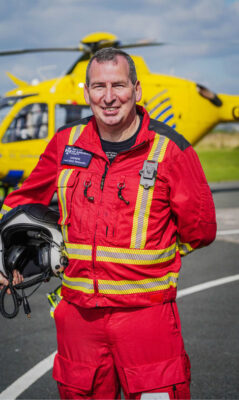
Andy is the Lead HEMS (Helicopter Emergency Medical Services) Paramedic for the charity’s emergency helicopter and vehicle crews
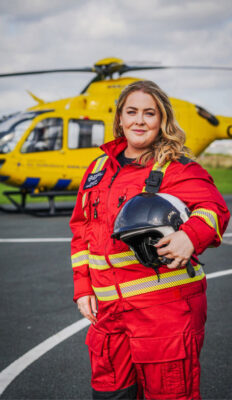
Dr Eimhear is an emergency consultant in the NHS and a consultant doctor with the North West Air Ambulance Charity
Andy said: “When we get called to a job, we don’t always have all the information. During the flight we’ll have a conversation about plan A, plan B, and plan C and we’ll do some calculations relating to drug dosages based on the age of the patient. As the scene is a live emergency environment, meaning something could change before we arrive on scene, we try to not make assumptions.
“What you can’t do is go as you’re approaching the scene thinking this patient is definitely going to need ‘X’ because you don’t know what you’re going to see until you get there. This might include putting them to sleep at the scene to preserve brain function.”
Andy added: “Wherever we are, we have to create an environment away from the immediate patient care to treat patients, while also reassuring their friends and family saying ‘right, this is what’s going to happen…’”
Eimhear said: “We’re there for critically injured and injured patients and we train extensively for every kind of situation. People trust us to do what we need to do, to treat their loved ones.
“Even though there are protocols and standard operating procedures that we would use, every patient gets nuanced care – it’s not a one-size-fits-all package.”

Ruby’s story
In 2022, Eimhear and Andy were called to help Ruby, 11, who had been thrown from her horse and trampled in Bury. The duo had to act fast to save Ruby’s eyesight and prevent potential brain damage.
The youngster, who was treated in a field where she had been riding her horse, had severe injuries to her head and torso and needed help fast.
Eimhear said: “We bring hospital-level interventions and equipment to the patient.
“They are getting interventions that are going to protect, save and enhance their outcomes much quicker than they would have done had they waited to get to a hospital.
“Critical care for us isn’t a place, it’s a thing – a thing that we can deliver anywhere.”
Eimhear used her emergency room experience to perform eye surgery at the scene.
She added: “We bring the hospital to the patient – and Ruby’s a perfect example. The intervention we performed at the scene was sight-saving.
“It’s that early intervention – being on scene, getting the right care, getting them to the right hospital at the right time, which helps save lives.”
At the scene, Ruby’s condition deteriorated and the team had to intervene, putting Ruby into a medically induced coma.
Eimhear explained: “With injuries to the head, you can’t see the damage inside to the skull and the brain. If you’ve got a brain injury, you need to be cared for ASAP. We provide intervention within five or ten minutes of arriving on scene.”
After carrying out the time-sensitive procedures, Ruby was flown to the best trauma centre to look after her injury, and it took just six minutes to fly Ruby to Royal Manchester Children’s Hospital.
Andy added: “By Eimhear being there with Ruby that day, we saved her eyesight, prevented brain injury, and took her to the right hospital. We did all the things that needed to be done for Ruby.”
The charity needs to raise more than £12 million each year to continue saving lives – it’s only thanks to the generosity of its supporters that it’s able to continue its lifesaving work.
>> Click here to make a donation <<
We do ‘impactful creativity’ —
work that delivers tangible results that:
• create demand for products and services
• make complex ideas simple
• position great places to work
• alter perception about places and brands
• turn brands into sector leads
• help owners maximise exit value
Call 01706 214340 | Email hello@vivapr.co.uk | Message
Institute of Technology will play vital role Blackpool’s future

Suprafilt names next managing director
Netflix: Bank of Dave 2 Project